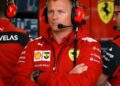
For many Formula 1 fans, the name Luca Badoer conjures up a fleeting memory from 2009—a mid-season replacement driver for Ferrari who struggled at the back of the grid in two underwhelming Grand Prix appearances. He was quickly dropped, harshly labeled by the media as “Ferrari’s worst-ever driver.” But that verdict, while dramatic, hardly tells the full story of a man who quietly gave over a decade of his life to Ferrari, helping shape championship-winning cars behind the scenes.

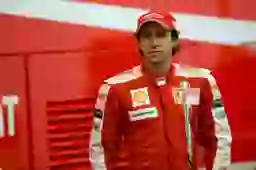
Badoer’s racing pedigree was never in doubt. In 1992, he became the International Formula 3000 Champion, defeating the likes of Rubens Barrichello and David Coulthard—names that would soon flourish in Formula 1. Naturally, big things were expected of him. But a string of bad luck and poor timing saw him relegated to the backmarker teams of the grid.
He made his F1 debut in 1993 with the struggling Scuderia Italia, and later raced for Minardi and Forti, all of whom lacked the resources to fight anywhere near the front. As a result, Badoer would go on to set an unfortunate record: most F1 race starts without scoring a single point—50 entries, and not one championship point to his name.
Yet, anyone who knew the sport well understood that statistics alone don’t reflect a driver’s true value. In 1998, Ferrari took Badoer on as their full-time test driver, and that’s where his greatest contributions would be made.
The Man Behind Ferrari’s Glory Years
For over a decade, Badoer remained loyal to Ferrari, operating in the shadows while Michael Schumacher, Rubens Barrichello, and later Felipe Massa and Kimi Räikkönen brought home wins and titles. Many within the paddock credited Badoer with being a vital part of Ferrari’s success. He drove countless kilometers in testing, helping fine-tune machinery that would dominate the sport from 2000 to 2004 and again in 2007.
He never once complained about his absence from race weekends. He never threatened to leave in pursuit of a better offer. He simply kept doing the work, one test at a time, year after year.
2009: The Unexpected Call-Up
Then came the twist.
In 2009, Felipe Massa suffered a terrifying injury during qualifying for the Hungarian Grand Prix, and Ferrari needed a replacement. Initially, it looked like Michael Schumacher would make a sensational comeback—but a neck injury ruled him out. In a surprise move, Ferrari turned to the man who had served them so loyally for 11 years: Luca Badoer.
Having not raced in F1 since 1999, and with no recent experience of the newer-generation cars or race-weekend pressure, it was always going to be a steep hill to climb.
He was thrown into the European Grand Prix in Valencia with minimal preparation—and it showed. He qualified and finished last, over 2 seconds off the pace. The media pounced. His second race at Spa-Francorchamps ended with a similar result. While fans had hoped for a fairy tale comeback, what they witnessed instead was a harsh reality: Badoer was out of his depth after a decade away from competitive driving.
After just two races, he was replaced by Giancarlo Fisichella.
The backlash was swift and unrelenting. Newspapers labeled him as “Ferrari’s worst-ever driver.” But even team insiders were taken aback by how personal and vicious the criticism had become. Badoer himself admitted in later interviews that he felt crushed—not just by his own performance, but by how the media turned on him.
“I did everything Ferrari asked of me for years. I never thought they would let the press humiliate me like that,” he said in a 2010 interview.
What many forget is that Badoer was asked to do the impossible: jump into a competitive F1 car, mid-season, with no testing, after being out of racing for 10 years. Add to that the weight of replacing Felipe Massa and representing Ferrari—the most scrutinized team in the sport—and it’s no surprise the task overwhelmed him.
Life After F1
After 2009, Badoer quietly disappeared from the spotlight. He has kept a low profile, occasionally attending events and test days, but he never returned to racing. He focused instead on his family and personal life. His son, Brando Badoer, has followed in his footsteps and is pursuing a racing career, offering a second chapter to the family name in motorsport.
Despite the scorn he received, Badoer is still held in high regard within Ferrari circles. Team engineers and past drivers often speak of his technical insight, patience, and loyalty.
It’s easy to laugh at statistics or dismiss someone based on two bad weekends. But Luca Badoer’s story is a reminder that Formula 1 is full of unsung heroes—people whose work happens far from the cameras, yet whose fingerprints are on every podium.
To call him Ferrari’s “worst-ever driver” is not only lazy, it’s unjust. He was, and remains, one of Ferrari’s most loyal and underrated contributors. And in a world that often forgets those who labor in silence, Badoer’s quiet devotion deserves far more recognition than ridicule.