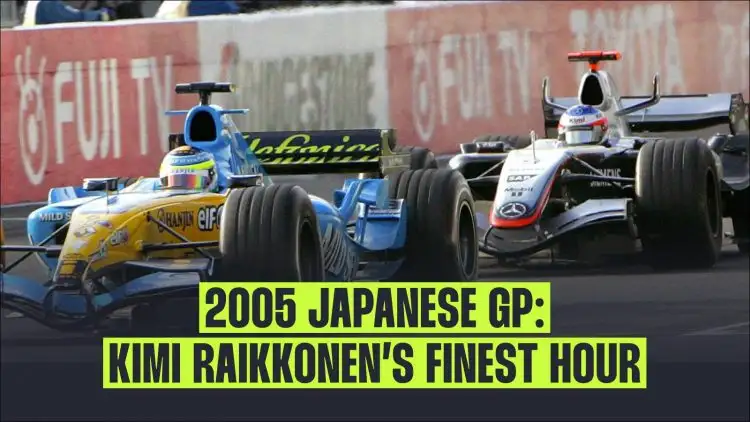
20 years later, one of Formula 1’s most thrilling comebacks still shines as a modern-day masterpiece.
As we mark two decades since the unforgettable 2005 Japanese Grand Prix, fans still remember Kimi Räikkönen’s sensational drive from 17th on the grid to a last-lap victory — a performance that remains one of the finest of the 21st century.
Back in 2005, the Japanese GP at Suzuka was a late-season classic, pivotal in the fierce fight between McLaren and Renault. Though Fernando Alonso had already sealed the drivers’ title in Brazil, McLaren was determined to snatch the Constructors’ Championship. The stage was set for a showdown at one of F1’s most iconic circuits.
The one-lap qualifying format, influenced by previous race results and race fuel load, threw a curveball at top contenders. A late-session downpour left big names scrambling. Alonso, Michael Schumacher, and Räikkönen were all caught out by worsening track conditions, qualifying deep in the field—14th, 16th, and 17th respectively. Juan Pablo Montoya, Räikkönen’s teammate, failed to set a time altogether.
In contrast, Renault’s Giancarlo Fisichella secured third, behind Toyota’s Ralf Schumacher and BAR’s Jenson Button — giving Renault a golden opportunity to extend their Constructors’ lead.
At lights out, Fisichella immediately passed Button to grab second behind Ralf, while Alonso pulled off a spectacular opening lap, climbing to eighth. Räikkönen wasn’t as lucky — a mistake at the chicane and Montoya’s crash left McLaren with just one car in the fight.
Alonso’s attempt to overtake Red Bull’s Christian Klien led to confusion with the stewards, as he had to yield and then retake the position — costing time and allowing Schumacher to build a gap. Meanwhile, Räikkönen started carving through the field.
By Lap 20, Alonso pulled off a now-iconic pass around the outside of Schumacher at the high-speed 130R. Kimi, still behind Schumacher, pitted shortly after and used the undercut to leapfrog the Ferrari, emerging ahead.
As Fisichella led with a comfortable gap, Alonso, Räikkönen, and Schumacher formed a charging trio behind. But after Alonso’s earlier pit stop, Kimi’s longer stint allowed him to leapfrog both Alonso and Schumacher during the pit cycle.
With 15 laps left, Fisichella rejoined the track just ahead of Räikkönen after his final stop. The Finn smelled opportunity. In a jaw-dropping display, Räikkönen slashed the gap with blistering pace—sometimes two seconds a lap faster.
Eight laps from the end, he pitted and rejoined in second. Now fully fueled, he had one goal: catch and pass Fisichella.
Fisichella defended into the final chicane, giving Kimi a better exit. On the last lap, using the slipstream down the main straight, Räikkönen swept around the outside into Turn 1 and took the lead — completing one of the most epic comebacks in F1 history.
Despite leading for just the final moments of the race, Räikkönen’s win was a masterclass in pace, patience, and perfectly executed strategy. McLaren boss Ron Dennis — rarely one for outward emotion — was moved to tears.
“That was his best race ever,” Dennis said, choking up.
“We had to dig deep, but this was a phenomenal team victory.”
Fisichella, visibly dejected, had no answers in the closing laps. Some misfortune — including a poorly timed Safety Car and traffic — played their part, but ultimately, Räikkönen’s drive was unstoppable.
Räikkönen’s win from P17 remains one of the lowest starting positions to yield victory in F1 history. Only a handful have matched or bettered it — including John Watson and Max Verstappen — but few with such style or drama.
“It was probably the best race of my career,” Räikkönen said post-race.
“I really enjoyed it. Everything came together.”
Though Renault eventually won the Constructors’ title in China, Suzuka 2005 stands out as a towering achievement in F1 history — a day when a driver, against all odds, turned chaos into glory.