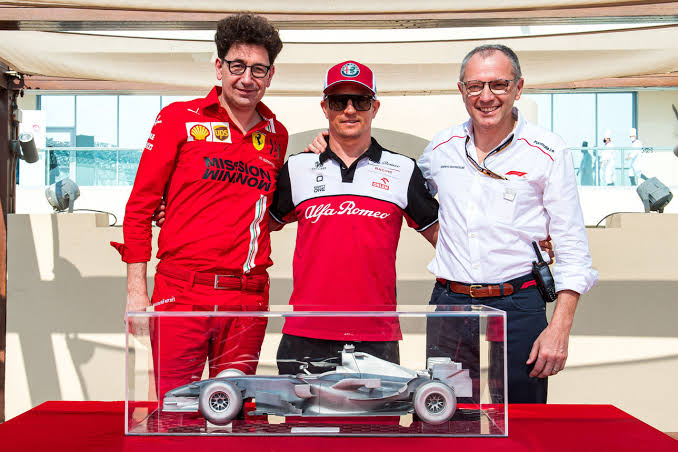

Kimi Räikkönen’s legacy in Formula 1 has never been defined by statistics alone. Yes, he is a world champion. Yes, he delivered unforgettable victories in red, silver, and black. But according to Formula 1 CEO and President Stefano Domenicali, the Finnish legend’s true impact goes far beyond trophies.
“Kimi Räikkönen didn’t just win races — he made millions of people fall in love with F1,” Domenicali reportedly said while reflecting on the careers of modern-era icons who shaped the sport’s global identity.
It is a powerful statement — and one that captures something numbers often miss.
Räikkönen arrived in Formula 1 in 2001 with little fanfare and limited single-seater experience. Yet within just a few races, it was clear he possessed rare natural speed. By 2003, he was fighting for a world championship. By 2007, he had etched his name into Ferrari folklore with one of the most dramatic title victories in the sport’s history.
But what made Kimi different wasn’t only his talent.
In an era increasingly dominated by polished PR messaging and corporate precision, Räikkönen stood apart. He was blunt, unscripted, and unapologetically himself. His radio messages became legendary. His interviews were often minimal. His approach to fame was detached — almost reluctant.
And fans loved him for it.
Domenicali, who worked closely with Räikkönen during his time at Ferrari, understands that magnetism better than most. Under his leadership today, Formula 1 has expanded into new markets, embraced digital storytelling, and grown its global fanbase to record levels. Yet drivers like Räikkönen laid the emotional foundation that modern growth builds upon.
“Kimi connected with people because he was authentic,” Domenicali is said to have reflected. “He didn’t try to play a role. He was real.”
That authenticity resonated far beyond traditional motorsport audiences. Casual viewers who might not have understood technical regulations or aerodynamic upgrades found themselves drawn to the sport through Kimi’s personality. He represented something rare — a reminder that at its core, Formula 1 is about human beings pushing limits, not just machinery chasing milliseconds.
Räikkönen’s 2007 championship remains one of Ferrari’s most treasured modern triumphs. His comeback to Formula 1 after a two-year hiatus, his podiums with Lotus, and his longevity across 349 Grand Prix starts all reinforced a simple truth: he raced because he loved racing.
Even in retirement, his presence lingers. Social media clips of classic “Iceman” moments continue to circulate. Younger fans discovering Formula 1 through streaming platforms still encounter his iconic radio line: “Leave me alone, I know what I’m doing.” It has become part of the sport’s cultural language.
Domenicali’s tribute underscores something often overlooked in debates about greatness. Influence is not measured solely in championships. It is measured in connection.
For nearly two decades, Kimi Räikkönen embodied a form of purity in Formula 1. He resisted transformation into a corporate persona. He never overexplained himself. He simply drove — fast, clean, and on his own terms.

And in doing so, he gave millions of fans a reason to care.
In the ever-evolving landscape of Formula 1, where technology, branding, and global expansion dominate headlines, it is easy to forget the emotional drivers who built the sport’s heart.
Kimi Räikkönen was one of them.
He didn’t just win races.
He made people fall in love with Formula 1.