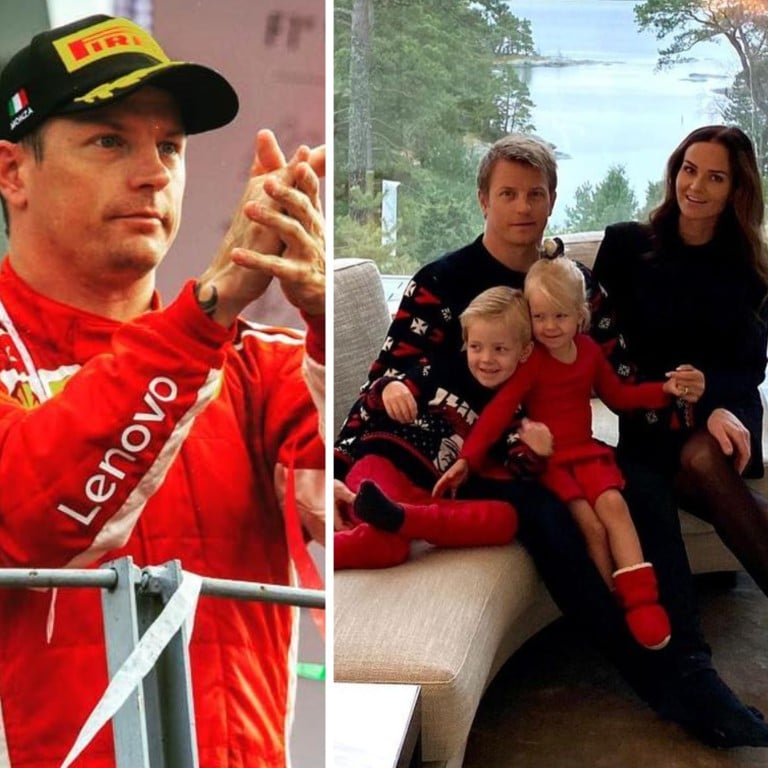
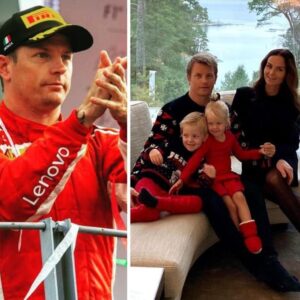
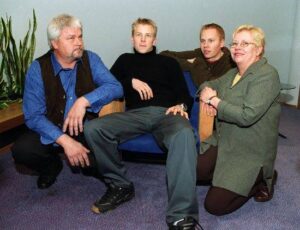
Kimi Räikkönen has always been an enigma. In a sport dominated by loud personalities, constant media noise, and carefully crafted public images, he chose silence. Fans called him The Iceman—not because he lacked emotion, but because he refused to perform it. Yet behind that famously closed-off demeanor stands a story rarely told: the profound influence of two women who shaped the man long before the world crowned him a Formula 1 legend—his mother, Paula Räikkönen, and his wife, Minttu Räikkönen.
Their roles were never visible on podiums or timing screens. Still, without them, the calm, resilient figure behind the visor may never have existed.
Long before champagne sprays and world titles, Kimi Räikkönen was a boy growing up in modest conditions in Espoo, Finland. His family life was far from glamorous. Resources were limited, and every step toward motorsport demanded sacrifice. At the heart of that sacrifice was his mother. While Kimi chased speed on frozen tracks and makeshift circuits, she provided something far more vital than funding—emotional stability.
Paula Räikkönen raised her son with quiet strength. She did not push him into the spotlight or chase dreams on his behalf. Instead, she allowed him to be exactly who he was—reserved, independent, and stubbornly focused. In a culture that values humility and resilience, she taught Kimi that words were less important than actions. That lesson would later define his entire career.
When financial pressure threatened to derail his early racing ambitions, his mother’s belief never faltered. She trusted his instincts even when the future was uncertain. That trust instilled in Kimi a rare self-assurance—one that did not rely on approval or applause. It is no coincidence that the same driver who could withstand relentless criticism and media scrutiny had learned emotional endurance at home.
Years later, when the world knew Kimi Räikkönen as a Formula 1 World Champion, another woman entered his life who understood him in a way few ever could. Minttu Räikkönen did not fall in love with the myth of the Iceman; she embraced the man behind it. Their relationship was built not on fame, but on balance.
Minttu brought warmth to a life defined by intensity. Where racing demanded precision and pressure, she offered normalcy and grounding. Friends close to the family have often noted how she became Kimi’s emotional anchor—someone who neither tried to change him nor demanded explanations for his silence. Instead, she gave him space to be himself, a gift he had learned to value from his upbringing.
As a wife and mother to their children, Minttu helped shape a new chapter in Kimi’s life. Fatherhood softened him, though never publicly. Away from the cameras, he became more reflective, more present, and more protective of his private world. Minttu’s influence ensured that home remained a sanctuary—free from the chaos of Formula 1.
What connects Kimi’s mother and wife is not just their place in his life, but their shared understanding of him. Neither woman tried to make him louder, more expressive, or more palatable to the public. They accepted his silence as a language of its own. In doing so, they reinforced the values that made him mentally unbreakable in a sport that consumes personalities.
Kimi Räikkönen never needed to explain himself because the people closest to him already understood. His mother gave him roots—discipline, humility, and emotional independence. His wife gave him wings—stability, love, and a life beyond racing. Together, they shaped a man who could walk away from Formula 1 on his own terms, unchanged by fame and unmoved by expectation.
In the end, the Iceman was never cold. He was simply grounded—built by a mother who taught him strength without noise, and a wife who taught him that silence can still be full of love.