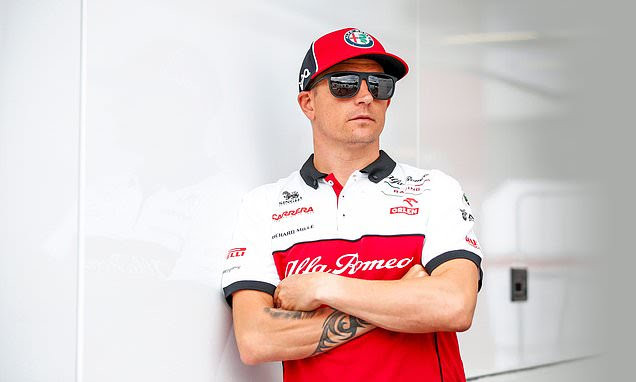
He’s the last Formula 1 world champion for Ferrari. He’s also one of the most enigmatic personalities to ever sit behind the wheel of a Grand Prix car. And he’s certainly the only one to make monosyllables feel like a form of art. Kimi Räikkönen has never played by the rules of celebrity, nor has he ever cared to.
In an era where athletes are as much media personalities as they are sportsmen, the Finnish driver has managed to cultivate a following by doing the exact opposite—by not caring, not engaging, and not pretending. And it’s precisely this resistance to the formula that makes him so beloved.
“Call me arrogant, if you want. I really don’t care,” Räikkönen tells me during a rare moment of candor, eyes scanning the bustling paddock. The line lands with the same icy finality that once silenced countless journalists, fans, and even team principals. But in that moment, it’s not arrogance—it’s liberation.
He isn’t dismissing the idea of reputation out of spite. He’s simply beyond it. “Why should I act like I care when I don’t?” he continues. “It doesn’t make me faster. It doesn’t help the team. So what’s the point?”
There’s an honesty to his words that cuts through the noise. Most athletes hide behind media-trained pleasantries. Kimi just tells you how it is, whether you like it or not.
The paradox of Räikkönen is that the more he avoids the spotlight, the more fans adore him. His deadpan radio messages—like the iconic “Leave me alone, I know what I’m doing”—have become meme-worthy mantras. His post-race interviews, often dry and disinterested, are dissected like ancient scripts, looking for hidden meaning. And his refusal to participate in F1’s social and political theater has made him something of an anti-hero in a sport increasingly filled with polished personas.
Yet, none of this was planned. He never tried to become a cult figure. It happened in spite of, or perhaps because of, his refusal to play the PR game. “If they like it, fine. If not, also fine,” he says, summing up his attitude toward fame with a shrug.
One of the few things that genuinely seem to light up Kimi’s expression is the mention of his son, Robin. The young Räikkönen has been spotted at karting tracks and paddocks, helmet on, laser-focused—just like his father once was. But Kimi is cautious.
“He should race only if he wants to. I won’t push him,” he says. “It’s a hard life. People think it’s all glamour, but it’s work. And pressure. And politics. If he likes it, good. If not, that’s good too.”
There’s a protective edge in Kimi’s voice, something rarely glimpsed behind the famously stoic exterior. It’s a reminder that behind the “Iceman” persona is a devoted father who, despite his unwillingness to be emotional in public, cares deeply about his family and the next generation.
Behind closed doors, Kimi is known by teammates and engineers as quietly thoughtful, even generous. One story that surfaced during his Alfa Romeo stint revealed that he bought his entire crew a round of drinks after a rough race weekend—without press, without social media, just out of respect. Another tells of how he refused to leave the garage until every mechanic had signed off on the car’s rebuild after a crash.
But you’ll never hear these stories from Kimi himself. “I’m not here to impress people with what I do off track,” he says. “It’s nobody’s business.”
Even after stepping away from Formula 1, Kimi hasn’t stopped racing. He’s competed in rallying, flirted with NASCAR, and continues to explore motorsport in his own independent way. Unlike other retired F1 drivers who move into commentary or team management, Kimi keeps a healthy distance from the circus he once ruled.
Would he ever return full-time to the paddock in another role? He pauses for a long second. “Maybe. But not if I have to sit in meetings all day. I hate meetings.”
It’s classic Kimi.
In a world obsessed with likes, followers, and curated content, Räikkönen’s apathy is a quiet rebellion. He doesn’t try to shape narratives. He doesn’t play to the crowd. And he certainly doesn’t smile for the camera unless there’s a reason.
But that’s precisely what makes him so fascinating. He is one of the last athletes whose greatness speaks for itself, whose words are few but never wasted, and whose silence often says more than others’ speeches.
As I left our conversation, I was struck by how little Kimi had said—and yet, how much he had revealed. He didn’t give me a headline. He gave me truth.
And in today’s world, that might just be the most powerful statement of all.