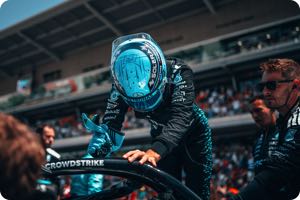
George Russell has stirred up debate in Finland and across the Formula 1 world with recent comments suggesting that Kimi Raikkonen’s famously no-nonsense and media-averse personality might not be well received by today’s fans.
In an interview quoted by motorsport-total.com, the 27-year-old Mercedes driver discussed how the sport has evolved in the era of social media, where drivers are expected to engage more personally with fans and project carefully maintained public images. Russell acknowledged that this digital shift has made life more complex for F1 drivers, both professionally and personally.
“To be honest, I don’t really show people who I am – it’s my way of protecting myself,” Russell admitted. “What you see online isn’t real life. Everyone wants to look their best. You won’t post the photo where you’re blinking or looking silly.”
The British driver explained that every post, every video, and every interaction is calculated to a certain extent—crafted to present a polished version of oneself. While many fans crave authenticity, Russell pointed out that true authenticity is difficult to achieve in an environment where content is scrutinized, shared, and archived permanently.
He also stressed that this curated reality isn’t necessarily dishonest—it’s a survival mechanism in an era where one misstep can lead to intense public backlash. “Everything is amplified now. Drivers are not just racers anymore—they’re public figures, influencers, brand ambassadors. That brings its own pressures.”
Russell was quick to emphasize the importance of fans in shaping the sport’s modern identity. “They’re the reason sponsors invest in the teams, which is how we make a living. You can’t ignore that. The world is changing, and we have to change with it.”
To illustrate his point, Russell brought up 2007 world champion Kimi Raikkonen, known for his monosyllabic interviews, no-frills attitude, and disinterest in fame. While Raikkonen’s behavior earned him cult-hero status in the 2000s, Russell speculated that such a personality might not thrive in today’s environment.
“Kimi had an amazing personality,” Russell said. “But if he debuted now as an 18-year-old and wasn’t on social media or came across as cold or disinterested, people might not respond well. That’s the reality we face in today’s environment.”
Raikkonen, often dubbed “The Iceman,” became a fan favorite precisely because of his refusal to play the media game, but Russell’s point raises an interesting question about whether that same defiance would be interpreted as arrogance or disengagement in 2025.
Unsurprisingly, Russell’s comments did not go over well in Raikkonen’s homeland. Finnish newspaper Iltalehti described the remarks as overly critical of the national icon, while Ilta Sanomat interpreted Russell’s reflections as a significant commentary on Raikkonen’s unique personality and how it clashes with modern expectations.
Although Russell did not directly criticize Raikkonen, his remarks have opened up a broader conversation about the changing nature of celebrity in Formula 1. Where once a driver could focus solely on performance, the modern competitor is now expected to be part athlete, part entertainer, and part brand ambassador.
As Formula 1 continues to grow its global fanbase—particularly among younger audiences via platforms like TikTok and Instagram—the tension between privacy and presence, authenticity and performance, is likely to become an even more central theme.