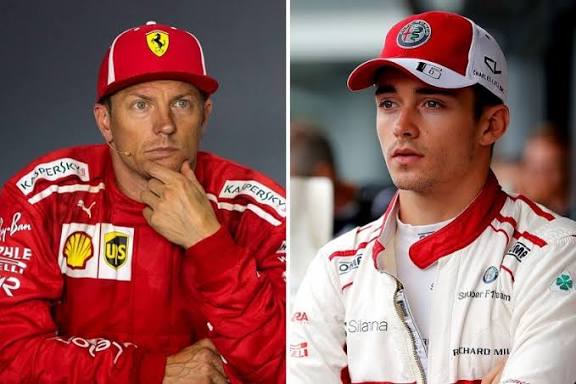

In a bold and thought-provoking assessment that has sparked debate across the paddock and among fans worldwide, Stefano Domenicali has weighed in on the contrasting decision-making styles of two Ferrari stars from different eras — Charles Leclerc and Kimi Räikkönen in his prime.
Comparing drivers across generations is never simple. Formula 1 evolves constantly — technically, strategically, and mentally. But according to Domenicali, while Räikkönen’s natural talent and fearless speed defined his peak years, Leclerc represents a more strategically refined product of modern Formula 1.
Domenicali’s perspective centers on one key element: decision-making under pressure.
During Räikkönen’s prime — particularly in his championship-winning 2007 season with Scuderia Ferrari — the sport demanded immense bravery and mechanical sympathy, but it was not yet as data-saturated as it is today. Drivers relied heavily on instinct, feel, and racecraft developed through experience. Räikkönen embodied that era perfectly. His style was raw, aggressive, and uncompromising. When he attacked, he did so without hesitation. When he defended, he trusted pure racing instinct.
However, modern Formula 1 is a far more complex battlefield.
Today’s drivers operate in an environment dominated by tire degradation models, live simulation data, energy deployment strategies, and constant radio input. Split-second decisions can determine whether a pit stop undercut works, whether tire preservation pays off in the closing laps, or whether pushing flat-out will backfire five laps later.
Domenicali suggested that Leclerc has shown an advanced ability to process these layers of information while still driving at the limit. His race management — particularly in high-pressure qualifying sessions and strategic duels — reflects a calculated intelligence that mirrors the evolution of the sport itself.
Leclerc’s performances since joining Ferrari in 2019 have showcased not only outright speed but also maturity in adapting to race circumstances. Whether managing tire life in turbulent conditions, judging when to attack versus when to consolidate points, or navigating complex team strategies, the Monegasque driver has demonstrated a cerebral approach that stands out in the modern era.
That is not to diminish Räikkönen’s greatness.
The Finn’s legacy is cemented by his 2007 World Championship, clinched in dramatic fashion at the Brazilian Grand Prix. His peak years — including electrifying campaigns with McLaren F1 Team — were defined by breathtaking speed and unshakeable composure. Räikkönen earned the nickname “The Iceman” for good reason; he rarely showed emotion and often let his driving speak louder than any strategic narrative.
But Domenicali’s comparison highlights how the demands on a driver’s mind have shifted. Modern F1 drivers must be part racer, part strategist, and part data interpreter. Leclerc’s edge, in Domenicali’s view, lies in how seamlessly he integrates those elements while maintaining elite pace.
The discussion has ignited passionate reactions among fans. Supporters of Räikkönen argue that prime Kimi’s instinctive brilliance would thrive in any era, while others agree that Leclerc’s polished decision-making reflects a driver built perfectly for today’s Formula 1 ecosystem.
Ultimately, the debate underscores something deeper: Formula 1 is not static. It reinvents itself constantly. What defined greatness in 2005 is not identical to what defines it in 2026. Drivers must evolve alongside the machinery and the analytics that shape race weekends.
Whether one agrees with Domenicali or not, the comparison shines a spotlight on two extraordinary talents — one a world champion whose cool demeanor became legendary, the other a modern star carrying Ferrari’s future ambitions on his shoulders.
Different eras. Different demands. Two brilliant minds behind the wheel.
And a debate that proves just how timeless greatness in Formula 1 truly is.